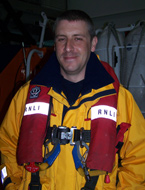
LEE FIRMAN |
|
|
Surname
|
Firman
|
Forename
|
Lee
|
Date of recording
|
2008
|
|
Year of birth
|
1977
|
Place of Birth
|
Scarborough
|
Occupation
|
\lifeboat coxswain
|
|
Fathers occupation
|
Coxswain
|
Present Address
|
Aldeburgh
|
Location Interview
|
Aldeburgh
|
|
Interviewer
Summary |
Charlie Damonsing
|
Duration
|
51 Mins
|
\no of tracks: 1
|
|
Detailed Contents (times in minutes)
This recording consists of 1 track. Track 1 [51mins.33 secs] Interviewed by Charlie Damonsing in 2008 at Aldeburgh Lifeboat Station. Lee was born in Scarborough and came to Aldeburgh in 1994 when his father was made Coxswain of the Aldeburgh Lifeboat. Mentioned that he later joined the crew of the lifeboat and has been on the crew for 14 years and is now himself Coxswain. Describes that there are two full time positions at the lifeboat, himself and a mechanic, Steve Saint. Describes there are approximately 18 volunteer crew members who are available to go to sea, and there are approximately 14/15 shore crew members who help launch and recover the boat. There are two lifeboats, one in-shore and one off-shore. Describes that the off-shore lifeboat usually has a crew of 6/7 while the in-shore boat has a crew of only 3 or 4. There are also 2 tractor drivers to launch the boats. Describes how all the volunteers are needed when there is a risk of flooding in the area as in November 2007, when a storm surge threatened the town. Describes how this surge was approximately 3 metres above the tide and the lifeboat crew were on alert from the Thursday evening until high water the following Friday morning. Describes how, luckily for the town the surge arrived before the high tide and only the Brudenell end of the town was slightly flooded. Describes how the high tide in the river is two hours later and the surge came up the river and topped the river wall towards Brick Dock. Describes how the crew went about the town warning people of what might happen. Describes how the shingle on the sea side does offer a certain amount of protection for the town, but further along towards the Brudenell and Martello Tower this levels out and can prove more likely to flood. Mentions that there was a lot of concern as to whether the river wall would hold as it had not been maintained very well, but it did hold quite well. Describes how The Environment Agency has repaired the wall where it did top and has raised it slightly. Describes the threat of flooding to Aldeburgh and mentions two threats, one from the sea and one from the river. Describes the lowest point in town is the roundabout which could be flooded from the river, thus cutting off the town, and the lowest point on the sea side is the Thorpeness Road and this would effectively cause Aldeburgh to become an island. Describes the work of the inshore lifeboat and mentions the Shingle Street entrance to the rivers Ore and Alde as being one of the most notorious entrances in the country as there is always shifting shingle which is never in the same place from week to week. Mentions that even people who regularly use this entrance experience problems. Describes how the entrance is buoyed from April to October by Trinity House, but during the winter months people are left to work it out on their own. Mentions that visiting leisure crafts use old sea charts and struggle with the entrance. Describes how both the off-shore and in-shore boats get called out when boats run aground at this entrance and describes that with a 6 knot tide which is very strong this happens quite frequently. Describes how sometimes people will just put an anchor out and wait for the tide to take them off, but at night time this can be quite scary and if there is any possibility of danger the lifeboat will come and assist. Describes how the lifeboat is there to save lives and not property and will take people off their boats first and then tow the boat. Describes people using the entrance come from as far as Holland as well as locally from Levington and the south coast. Mentions that the in-shore boat is quite busy in the summer months towing boats that have gone aground. Mentions that the river in August is probably as busy as the Solent with sailing craft in the summer and it can be quite dangerous if someone falls in as the tide in the river can run at 3 to 4 knots. Mentions that the yacht club does provide its own safety craft during the day. Describes how the lifeboat is sometimes called out by the Coastguard when yachtsmen are overdue or people see an empty boat aground and the lifeboat assists in finding the owners who may have fallen in, but does mention that sometimes the owner may have walked off to find help and assistance is not needed. Describes how the lifeboat is called out by the coastguard after receiving either a 999 call or a call on Marine VHF radio. Describes the river up to Snape where it becomes very narrow and is marked by sticks, called withies, which are replaced every year by the yacht club who have taken on the responsibility. Describes how at low water the channel can easily be seen but at high water it is much more difficult. Mentions that the distance from the entrance at Shingle Street to Aldeburgh is about ten miles and from Aldeburgh to Snape a further 6 miles. Describes how sometimes the river can become very rough (Lee describes it as a short sharp sea), very quickly and people can be caught out. Describes a couple of rescues in this sort of weather, one a wildfowler who got into trouble and another an overturned sailing boat with a couple of people trapped underneath. Describes the Butley River up to Butley Creak where the entrance is not marked and tells of another rescue when someone had seen red flares go off. The in-shore lifeboat was launched and they also became aground as the night was very dark. Describes how they lit a parachute flare which is very bright which enabled them to find the water again and complete the rescue. Describes how nasty the entrance at Shingle Street can be at night, with the grinding noise of the shingle and the sound of rushing water. Describes how some people are embarrassed to call out the lifeboat and will sit on the shingle until and tide turns. Describes how they crew do not judge anyone and the sooner they call and get help the better. Describes users of the river, wildfowlers, fishermen at Orford and sometimes chartered angling boats who sometimes get into trouble out at sea. Describes how the off-shore boat will tow them back to the entrance and sometimes will hand them over to other returning boats to tow them up to Orford as the lifeboat does not particularly want to get trapped in the river with the falling tide and needs to get back to the station on the sea side. Continues to describe the users of the river as leisure craft, water skiers, fishermen, mentions there are a couple of boatyards that do repairs and build boats. Mentions there is an oyster fisherman who has oyster beds on the sea side of the Martello Tower and sells his oysters from a shed near the lifeboat station. Describes the in-shore boat rescuing a young steer in the river who had been swimming about for 4 hours and was totally exhausted. Also describes rescuing a horse from the river, with the help of the fire brigade and the RSPCA. Mentions there have been bombs trawled up by nets in the river. These were bombs dropped by the Germans on their way home and most of them have now been exploded. Lee believes there is only one left. Describes how the in-shore boat acts as a safety boat for the bomb disposal team, keeping people away while the bomb is detonated. Describes how as long as the lifeboats are busy there will always be a station at Aldeburgh, the next nearest being an in-shore boat at Southwold and two further off-shore boats at Lowestoft and Harwich, some 20 miles away. Describes how he feels Aldeburgh has not changed much and how he is very happy living in this unique and very friendly town. |